High-Speed IOC Correlation: A Python Pipeline for Analysts & Researchers
Correlate millions of logs in seconds with a schema-validated, idempotent pipeline using Pandas, DuckDB, and Pandera.

Abstract
A compact, vendor-agnostic pipeline that correlates large endpoint-log batches with IOC feeds in seconds.
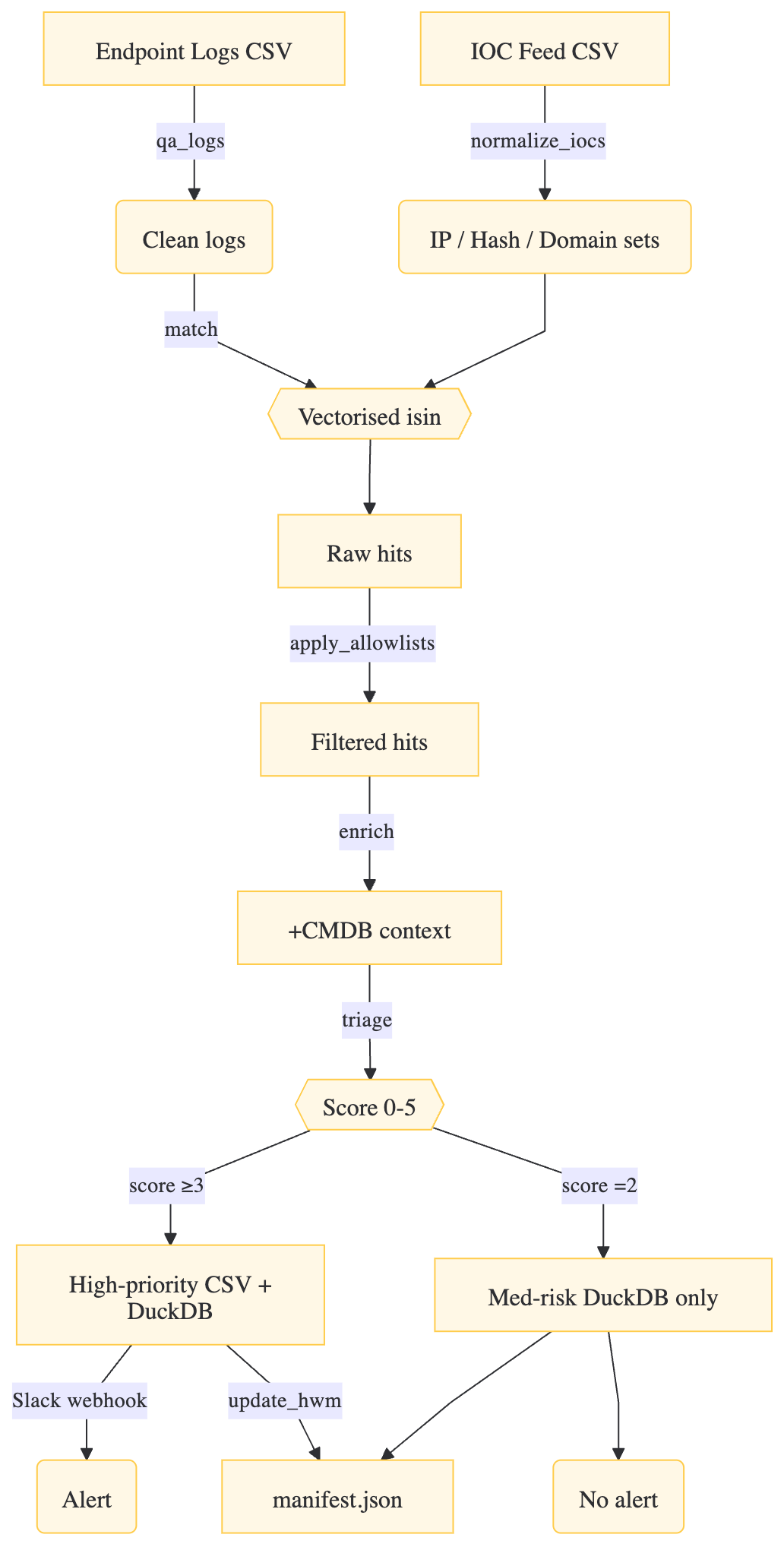
It emphasises: schema validation (fail-fast), vectorised set matching (deterministic and fast), idempotent ingestion (safe re-runs), CMDB enrichment (context), a transparent triage policy (auditable), and a tiny operational footprint (DuckDB + systemd + Slack).
Objective
Engineer a reproducible IOC-correlation workflow that:
rejects bad inputs via strict contracts
matches at O(n+m) using set membership (no row loops)
enriches with CMDB for user / department context
scores hits with a clear, explainable policy
writes idempotently with a high-water mark
alerts only on signal (non-empty high-priority results)
Everything below ships as a single Python CLI.
Pipeline at a Glance
1. The Complete Pipeline Script (hunt.py)
Save as hunt.py, chmod +x hunt.py, and run.
#!/usr/bin/env python3
import os
import sys
import argparse
import json
from pathlib import Path
from ipaddress import ip_address, ip_network

import pandas as pd
import pandera as pa
from pandera import typing as pat
import requests
import duckdb

# ---------------------------
# 1. SCHEMA DEFINITIONS (PANDERA)
# ---------------------------
class IOCs(pa.SchemaModel):
    indicator: pat.Series[str]
    type: pat.Series[str] = pa.Field(isin=[”ip”, “hash”, “domain”])

class Logs(pa.SchemaModel):
    timestamp:      pat.Series[pa.DateTime]
    hostname:       pat.Series[str]
    destination_ip: pat.Series[str] = pa.Field(nullable=True)
    file_hash:      pat.Series[str] = pa.Field(nullable=True)
    process_name:   pat.Series[str] = pa.Field(nullable=True)

class Assets(pa.SchemaModel):
    hostname:     pat.Series[str]
    primary_user: pat.Series[str] = pa.Field(nullable=True)
    department:   pat.Series[str] = pa.Field(nullable=True)
    os_version:   pat.Series[str] = pa.Field(nullable=True)
    last_patch:   pat.Series[str] = pa.Field(nullable=True)

# ---------------------------
# 2. CORE HELPERS
# ---------------------------
READ_OPTS = dict(dtype=str, keep_default_na=False,
                 na_values=[”“, “null”, “NULL”, “NaN”])

SUSPICIOUS = {”powershell.exe”, “wscript.exe”, “cmd.exe”, “curl”, “rundll32.exe”}
SENSITIVE  = {”Finance”, “HR”, “Exec”, “Legal”}

def normalize_iocs(df: pd.DataFrame):
    df = df.assign(
        indicator=df[”indicator”].astype(str).str.strip(),
        type=df[”type”].str.lower().str.strip()
    )
    ip_set     = set(df.loc[df.type == “ip”,    “indicator”])
    hash_set   = set(df.loc[df.type == “hash”,  “indicator”])
    domain_set = set(df.loc[df.type == “domain”,”indicator”])
    return ip_set, hash_set, domain_set

def qa_logs(df: pd.DataFrame) -> pd.DataFrame:
    df = df.dropna(subset=[”destination_ip”, “file_hash”], how=”all”)
    df[”timestamp”] = pd.to_datetime(df[”timestamp”], errors=”coerce”, utc=True)
    df = df.dropna(subset=[”timestamp”])
    for col in [”hostname”, “destination_ip”, “file_hash”, “process_name”]:
        if col in df.columns:
            df[col] = df[col].astype(str).str.strip()
    return df

def match(logs: pd.DataFrame, ip_set: set, hash_set: set) -> pd.DataFrame:
    return logs[
        logs[”destination_ip”].isin(ip_set) |
        logs[”file_hash”].isin(hash_set)
    ].drop_duplicates()

def enrich(hits: pd.DataFrame, assets: pd.DataFrame) -> pd.DataFrame:
    assets = assets.drop_duplicates(”hostname”)
    out = (hits.merge(assets, on=”hostname”, how=”left”)
           .assign(patch_age=lambda x:
                   (pd.Timestamp.now(tz=”UTC”) -
                    pd.to_datetime(x[”last_patch”], errors=”coerce”)).dt.days))
    cols = [”timestamp”, “hostname”, “primary_user”, “department”,
            “process_name”, “destination_ip”, “file_hash”,
            “os_version”, “patch_age”]
    return out.reindex(columns=cols, fill_value=pd.NA)

def apply_allowlists(df: pd.DataFrame, cidrs=None, golden_hashes=None) -> pd.DataFrame:
    nets = [ip_network(c) for c in (cidrs or [])]
    good = set(golden_hashes or [])

    def ip_ok(ip):
        try:
            return any(ip_address(ip) in n for n in nets)
        except Exception:
            return False

    if “destination_ip” in df:
        df = df[~df[”destination_ip”].map(ip_ok)]
    if “file_hash” in df:
        df = df[~df[”file_hash”].isin(good)]
    return df

def triage(df: pd.DataFrame):
    if df.empty:
        return df.assign(score=[]), df.head(0)
    df = df.copy()
    df[”score”] = (
        (df[”file_hash”].notna()).astype(int) * 2 +
        (df.get(”process_name”, “”).str.lower().isin(SUSPICIOUS)).astype(int) +
        (df.get(”department”, “”).isin(SENSITIVE)).astype(int) +
        (df.get(”patch_age”, 0).fillna(0).astype(float) > 30).astype(int)
    )
    hi = df[df[”score”] >= 3].sort_values([”hostname”, “timestamp”])
    md = df[df[”score”] == 2].sort_values([”hostname”, “timestamp”])
    return hi, md

def high_water_mark(path=”out/manifest.json”) -> pd.Timestamp:
    p = Path(path)
    if not p.exists():
        return pd.Timestamp(”1970-01-01”, tz=”UTC”)
    return pd.to_datetime(json.loads(p.read_text())[”max_ts”], utc=True)

def update_hwm(ts: pd.Timestamp, path=”out/manifest.json”):
    Path(path).write_text(json.dumps({”max_ts”: ts.isoformat()}))

def write_duckdb(df: pd.DataFrame, db=”out/risk.duckdb”, table=”current_risk”):
    con = duckdb.connect(db)
    con.execute(f”CREATE TABLE IF NOT EXISTS {table} AS SELECT * FROM df LIMIT 0”)
    con.register(”df”, df)
    con.execute(f”INSERT INTO {table} SELECT * FROM df”)

def send_slack_alert(df: pd.DataFrame, url: str):
    if not url:
        print(”WARN: SLACK_WEBHOOK_URL not set; skipping alert.”, file=sys.stderr)
        return
    n, h = len(df), df[”hostname”].nunique()
    top = df.groupby(”hostname”).size().sort_values(ascending=False).head(3)
    hosts = “\n”.join([f”• `{k}`: {v} hits” for k, v in top.items()])
    payload = {
        “text”: f”IOC correlation: {n} high-priority rows across {h} host(s)”,
        “blocks”: [
            {”type”: “section”, “text”: {”type”: “mrkdwn”,
                                         “text”: f”:warning: *IOC correlation:* `{n}` rows / `{h}` host(s)”}},
            {”type”: “section”, “text”: {”type”: “mrkdwn”,
                                         “text”: f”*Top hosts:*\n{hosts}”}}
        ]
    }
    try:
        requests.post(url, json=payload, timeout=10).raise_for_status()
    except requests.RequestException as e:
        print(f”WARN Slack: {e}”, file=sys.stderr)

# ---------------------------
# 3. ORCHESTRATOR
# ---------------------------
def main():
    ap = argparse.ArgumentParser(description=”IOC correlation pipeline”)
    ap.add_argument(”--assets”, required=True, help=”Path to CMDB assets CSV”)
    ap.add_argument(”--logs”,   required=True, help=”Path to endpoint logs CSV”)
    ap.add_argument(”--ioc”,    required=True, help=”Path to IOC feed CSV”)
    ap.add_argument(”--out”, default=”out/high_priority_incidents.csv”,
                    help=”Output path for high-priority CSV”)
    ap.add_argument(”--db”, default=”out/risk.duckdb”,
                    help=”Output path for DuckDB file”)
    ap.add_argument(”--since-file”, default=”out/manifest.json”,
                    help=”Path for manifest/high-water-mark file”)
    ap.add_argument(”--allow-cidr”, nargs=”*”, default=[],
                    help=”CIDR allowlist (e.g., 10.0.0.0/8)”)
    ap.add_argument(”--allow-hash”, nargs=”*”, default=[],
                    help=”Known-good hash allowlist”)
    args = ap.parse_args()

    # READ
    assets = pd.read_csv(args.assets, **READ_OPTS)
    logs   = pd.read_csv(args.logs,   **READ_OPTS)
    iocs   = pd.read_csv(args.ioc,    **READ_OPTS)

    # Optional schema validation:
    # IOCs.validate(iocs); Logs.validate(logs); Assets.validate(assets)

    # TRANSFORM
    max_ts = high_water_mark(args.since_file)
    logs   = qa_logs(logs)
    logs   = logs[logs[”timestamp”] > max_ts]
    if logs.empty:
        print(”OK: no new rows”)
        return

    ip_set, hash_set, _ = normalize_iocs(iocs)
    hits  = match(logs, ip_set, hash_set)
    hits  = apply_allowlists(hits, cidrs=args.allow_cidr,
                             golden_hashes=args.allow_hash)
    rep   = enrich(hits, assets)
    hi, md = triage(rep)

    # LOAD
    Path(args.out).parent.mkdir(parents=True, exist_ok=True)
    Path(args.db).parent.mkdir(parents=True, exist_ok=True)
    Path(args.since_file).parent.mkdir(parents=True, exist_ok=True)

    if not hi.empty:
        hi.to_csv(args.out, index=False)
        write_duckdb(hi, db=args.db, table=”current_risk”)
        update_hwm(hi[”timestamp”].max(), args.since_file)
        send_slack_alert(hi, os.environ.get(”SLACK_WEBHOOK_URL”))
        print(f”OK: {len(hi)} high-priority rows -> {args.out} & {args.db}”)
    elif not md.empty:
        write_duckdb(md, db=args.db, table=”medium_risk”)
        update_hwm(md[”timestamp”].max(), args.since_file)
        print(f”OK: {len(md)} medium rows -> {args.db} (no alert)”)
    else:
        print(”OK: no new hits”)

if __name__ == “__main__”:
    main()
2) Deconstruction (Why Each Part Exists)
Inputs & Contracts: Fail-fast contracts prevent “garbage in” from contaminating results. Optional Pandera schemas make assumptions executable.
CSV Hygiene:
dtype=strand customna_valuesavoid pandas’ guesswork (e.g., hashes read as floats).Deterministic Matching: IOCs $\rightarrow$ Python sets; vectorized
isin$\rightarrow$ $O(n+m)$ membership checks, no row loops.Enrichment Join:
Left-joinwith CMDB keeps hits even if inventory is stale; computepatch_agefor risk.Noise Reduction: Pre-triage allowlists (CIDR & golden hashes) strip known-good traffic.
Transparent Triage: Rule-based, auditable scoring: hash hit > IP hit; suspicious process; sensitive department; patch age.
Idempotent Ingestion: High-water mark in
out/manifest.jsonensures safe re-runs; DuckDB is a fast, file-based sink.Native Alerting: Slack webhook (env var) with concise, host-grouped summary; no
curl.
3) Run & Schedule
Manual run
export SLACK_WEBHOOK_URL=”https://hooks.slack.com/services/XXXX/YYYY/ZZZZ”
python3 hunt.py \
  --assets ./data/cmdb_export.csv \
  --logs   ./data/endpoint_logs.csv \
  --ioc    ./data/ioc_feed.csv \
  --out    ./out/high_priority_incidents.csv \
  --db     ./out/risk.duckdb \
  --since-file ./out/manifest.json \
  --allow-cidr 10.0.0.0/8 192.168.0.0/16
systemd service (/etc/systemd/system/ioc-correlation.service)
[Unit]
Description=IOC Correlation Pipeline

[Service]
Type=oneshot
Environment=PYTHONUNBUFFERED=1
Environment=”SLACK_WEBHOOK_URL=https://hooks.slack.com/services/XXXX/YYYY/ZZZZ”
WorkingDirectory=/opt/ioc
ExecStart=/usr/bin/python3 /opt/ioc/hunt.py \
  --assets /opt/ioc/data/cmdb_export.csv \
  --logs   /opt/ioc/data/endpoint_logs.csv \
  --ioc    /opt/ioc/data/ioc_feed.csv \
  --out    /opt/ioc/out/high_priority_incidents.csv \
  --db     /opt/ioc/out/risk.duckdb \
  --since-file /opt/ioc/out/manifest.json \
  --allow-cidr 10.0.0.0/8 192.168.0.0/16
systemd timer (/etc/systemd/system/ioc-correlation.timer)
[Unit]
Description=Run IOC Correlation every 15 minutes

[Timer]
OnCalendar=*:0/15
Persistent=true

[Install]
WantedBy=timers.target
4) Performance, Testing, and Extensions
Benchmarks (laptop baseline)
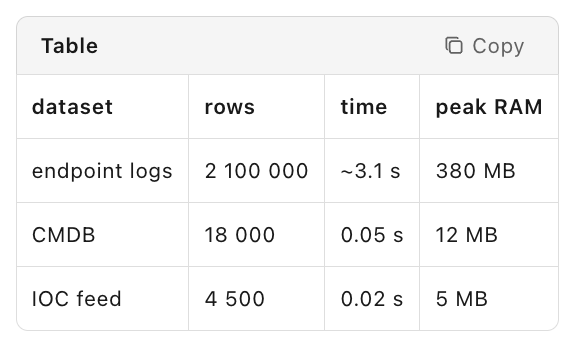
Tips – install pyarrow for faster CSV IO; ≥50 M rows → switch to Polars or chunked reads; ≥1 M hash IOCs → front with a Bloom filter (~0.1 % FP).
Sanity tests
import pandas as pd, numpy as np
from hunt import qa_logs, triage

def test_drop_rows_without_observables():
    df = pd.DataFrame([
        {”timestamp”:”2024-01-01T00:00:00Z”,”hostname”:”h”,
         “destination_ip”:np.nan,”file_hash”:np.nan},
        {”timestamp”:”2024-01-01T00:00:01Z”,”hostname”:”h”,
         “destination_ip”:”1.2.3.4”,”file_hash”:np.nan},
    ])
    out = qa_logs(df)
    assert len(out) == 1 and out.iloc[0][”destination_ip”] == “1.2.3.4”

def test_triage_policy():
    rep = pd.DataFrame([{
        “timestamp”: pd.Timestamp.now(tz=”UTC”), “hostname”:”h1”,
        “primary_user”:”u”,”department”:”Finance”,
        “process_name”:”powershell.exe”,”destination_ip”:”2.2.2.2”,
        “file_hash”:”a1b2”,”os_version”:”win”,”patch_age”:45.0
    }])
    hi, md = triage(rep)
    assert len(hi) == 1 and hi.iloc[0][”score”] >= 3
Security & ops hygiene
chmod 600on CSV/DB/manifestRetain outputs 30–90 d; rotate
Version triage thresholds; keep changelog
Redact or hash
primary_userin external alerts if policy requires
Extensions
Domains – add
destination_domain+ punycode normalisation; match againstdomain_setATT&CK – include
technique_idin IOC feed; export Navigator layer JSONStreaming – wrap core in a Kafka consumer; emit enriched hits downstream
SOAR – open tickets automatically for high-priority rows with CMDB context
#ThreatHunting #DetectionEngineering #CyberSecurity #InfoSec #Python #Pandas #DuckDB #DataPipeline #SecurityAutomation #IOC #LogAnalysis #ETL #ThreatIntel #EndpointSecurity #DataValidation #BlueTeam #SecurityAnalytics #Code #Scripting #DataQuality #Deterministic #Reproducibility #CyberResearch #SecurityResearch #ThreatResearch #DigitalForensics #SecurityTools #OpenSourceSecurity